
Long before it appeared on menus, bilimbi lived in gardens, games and childhood rituals. Its journey back to the table reveals how flavour can hold the shape of belonging long after we leave home.
The humidity of Sri Lanka in July has a specific weight to it, a thick blanket that clings to the skin and slows the pulse. For someone who spent their childhood in the dry heat of the Middle East, this humidity was the first heavy greeting of being back on the island.
Holidays in Sri Lanka had many highlights but nothing quite compared to being jolted awake by birds shrieking outside the window or the laughter of neighbourhood kids chasing each other through unfenced gardens. My grandparents’ garden was a place where wild things felt at home, guarded by the aptly named Mischief, a local canine. Trees and plants crept everywhere, their limbs sometimes merging to form entirely new species. This garden was home to the protagonist of our story, the Biling, also formally known as Bilimbi.
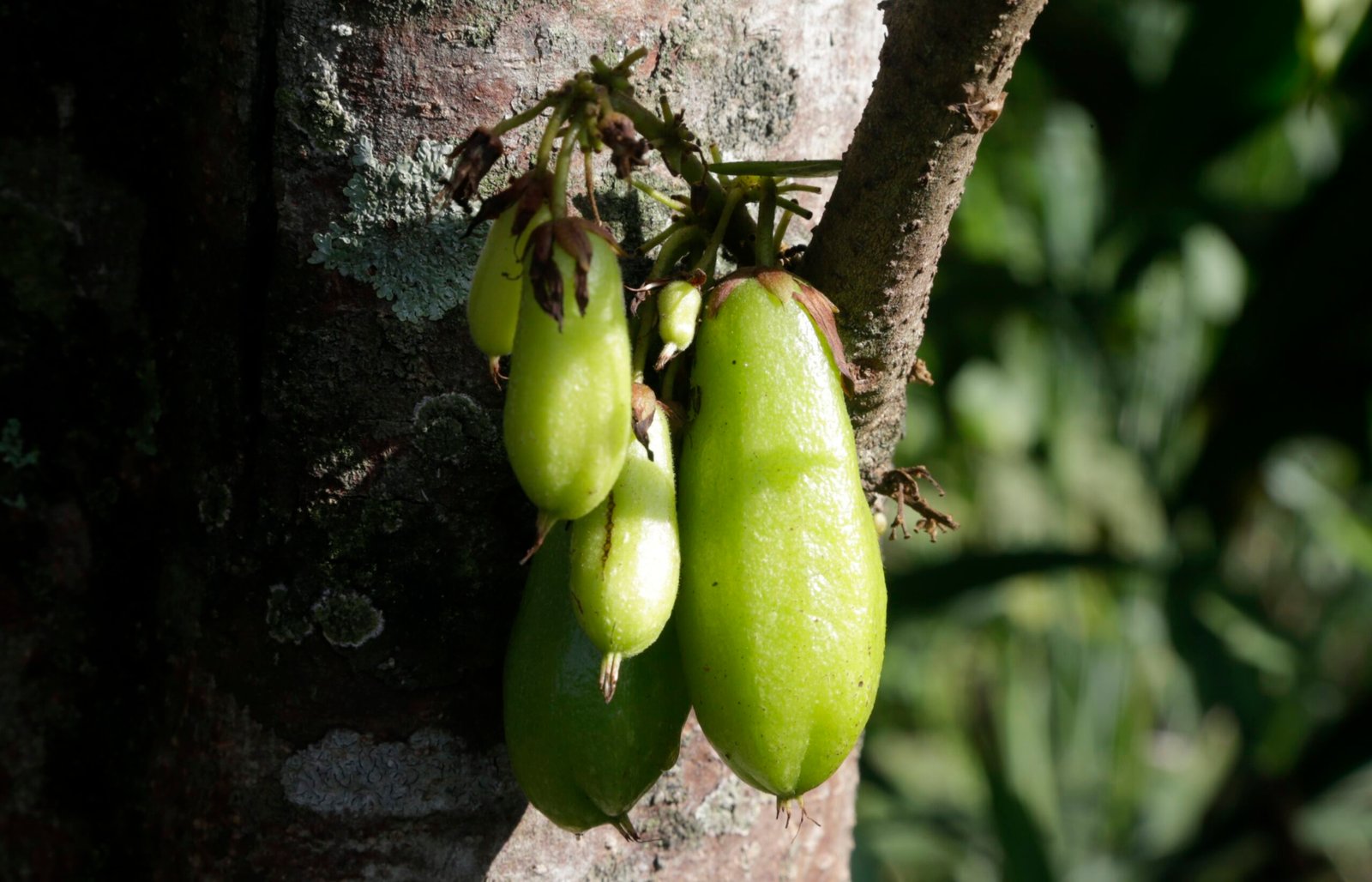
The Biling tree (known scientifically as Averrhoa bilimbi) is cauliflorous, meaning the flowers and fruit grow directly from the trunk and oldest branches. This gives the tree a strange appearance, as if the fruit is erupting from the wood itself. Once native to the Maluku Islands of Indonesia1, over the years it was carried across the seas through migration and trade as it made its way across South Asia and Africa.
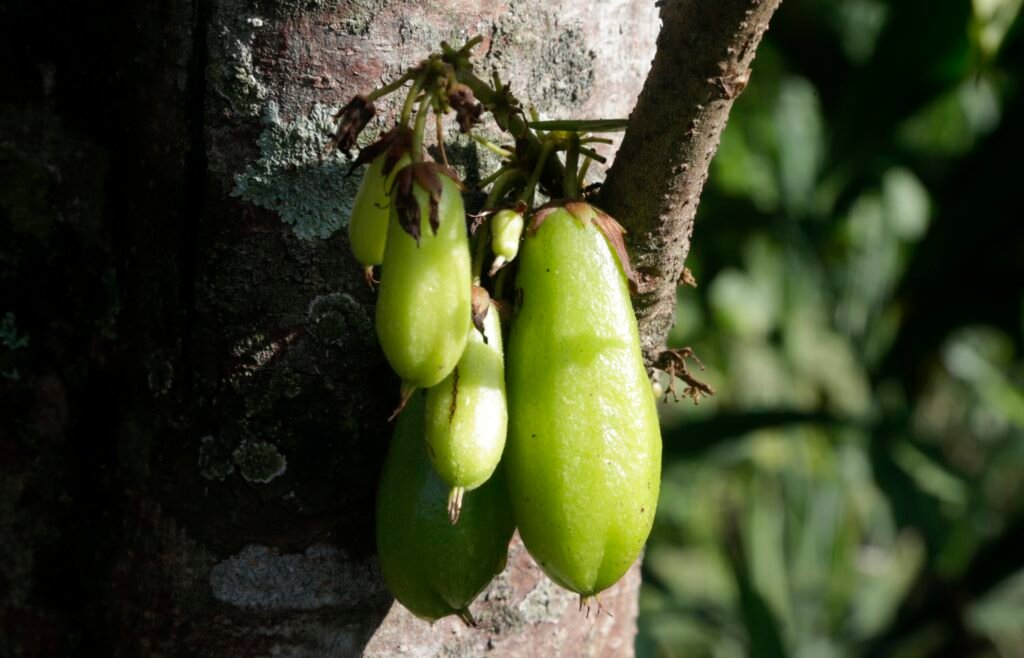
For us children in the wild summers of the early 2000s, it was a tree of penance. The harsh sourness of the fruit delivered a sharp, electric jolt that bypassed the tongue and vibrated straight into the bone. The second bite was somehow worse; despite the expectation of the sting, your body still recoils. It became the perfect tool of justice.
If you lost a race, you braved the fruit as punishment for being slow; if you missed a day of play, you were re-indoctrinated into the group only after consuming a Biling.
We would watch each other, waiting for the first flinch and face-scrunch that signalled defeat. To eat a Biling with a straight face was to prove you truly belonged to the island. We would clutch our araliya necklaces, eyes watering, swallowing the pride and the acid in one go.
Our childhood whimsy shielded us from a larger truth: the Biling was a versatile titan across the continent. For centuries, it had been a staple in Asian kitchens; eaten raw, pressed into tart juices, or simmered into thick preserves, pickles, and chutneys. In Indonesia2it provided the sharp backbone for fiery sambals and fish curries; in India, it lent a fruity tang to curries 3; while in the Philippines, it was used as flavouring for candy4.
The Biling was as much a tool as it was a treat. Its high acidic juice was a legendary stain remover5 and was even added to homemade soaps and cleaning supplies6, a testament to the fact that the very thing that made us pucker could also polish the world around us.
Beyond its culinary bite, the Biling is a nutritional powerhouse. It is a reservoir of essential antioxidants, specifically packed with Vitamin C7. The fruit is rich in tannins and terpenes, compounds that provide significant anti-inflammatory benefits8.
Now, years after my return, I find myself embracing life’s sourness with a seasoned palate. To the adult version of me, the Biling is the ultimate grown-up ingredient. Where did I come to appreciate it? When I found myself seated at a new restaurant sharing the name of the fruit itself, Biling Resto Bar. The restaurant’s ambience carries the soul of a grandmother’s dining room, yet is polished with the chic, intentional edges of a modern catch-up spot, over drinks and good food. It is designed to celebrate our shared memory of Biling and is governed by a concept that makes familiar Sri Lankan flavours feel unexpected and thrilling. By braiding together Sinhalese roots and Burgher heritage, the menu proves that while these two culinary cultures may navigate the stove differently, they share the same beating heart: food crafted with an unwavering sense of love, care, and pride.
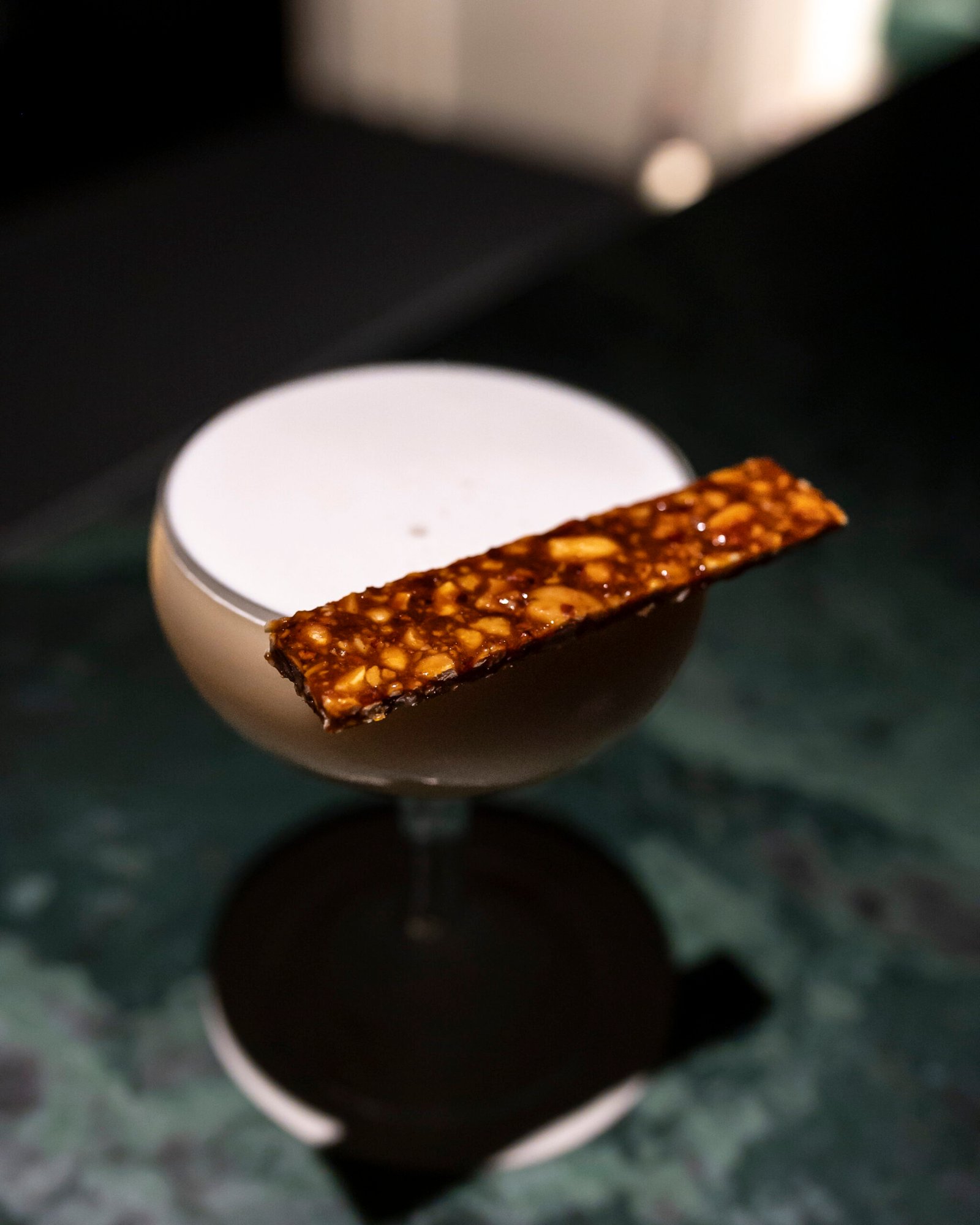
The Kale & Karapincha Butter starter, served with a sharp Biling chutney, was an incredible opening act and enough to erase that childhood sourness and allow me to appreciate its refined taste. It paired perfectly with Appi’s Kalu Pol Pork, a dish of rich pork belly in a smoky, burnt coconut sauce, topped with crispy pork crackling. The balance of the tart chutney against the deep, savoury pork created an incredible flavour profile that felt both new and deeply familiar. The Yannick’s Default cocktail was a bold Whisky-base layered with the tropical tartness of green mango and ambarella, finished with a house-made Biling achcharu syrup. As the first bite and sip hit, that familiar electric jolt vibrated straight into my jawline, just as it did decades ago under the canopy of my grandparents’ trees.
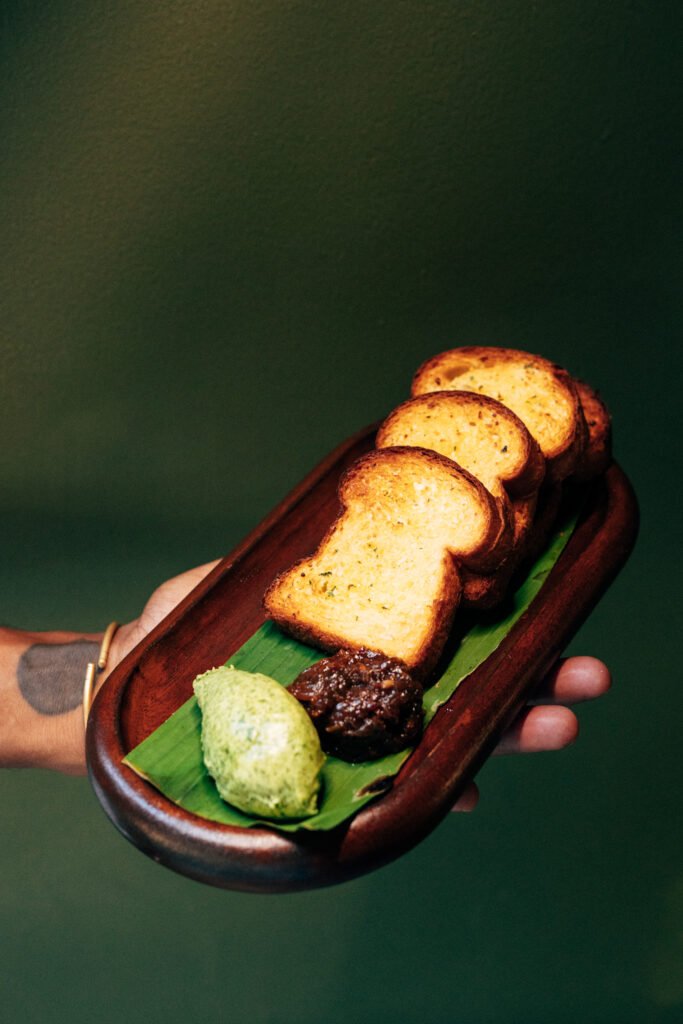
This time, I didn’t flinch. The sharp sourness doesn’t feel like a dare anymore; it feels like a homecoming. It’s as if the memory of those summers has been distilled into something refined, cutting through the warmth of the whiskey with a clarity that only time can provide.
As I shared these memories with my partner over dinner, I realised that the fruit held a seat at everyone’s childhood table. In between each sip, memories of Mischief the dog, the shrieking birds of my grandmother’s garden and the dares that made our summers in Sri Lanka played into our conversation naturally.
It turns out the Biling was our collective secret, a small, sour thread that connects us in the most unexpected ways across different backyards and different lives. I realise now that we spend our youth trying to escape the sourness of the island; the heat, the intensity, the sharp edges. But as we grow, we realise those are the very things that give us character.
The Biling is no longer a punishment for being the slowest kid in the garden. It has become a bridge that keeps us connected and reminds us that no matter where our lives have taken us, from the dry heat of the desert to the bustling streets of Colombo, the memory of the Biling tree stays firmly rooted within all of us. It turns out that to belong to the island, you don’t just have to stomach the sourness, you have to learn to love it.
Sources
1. D.K.N.G. Pushpakumara, “Averrhoa bilimbi L.” in Underutilised Fruit Trees in Sri Lanka (CIFOR–ICRAF)
2. “Umami compounds present in low molecular umami fractions of asam sunti — a fermented fruit of Averrhoa bilimbiL.” LWT – Food Science and Technology
3. Malabar Tea Room, “Bilimbi Masala”
4. “Averrhoa bilimbi and its health benefits,” Novelties in Research Sciences (Crimson Publishers)
5. “Oxalic acid from Averrhoa bilimbi L. as a bleaching agent,” Malaysian Journal of Chemistry
6. “Acceptability of kamias (Averrhoa bilimbi L.) fruit extract as an additive for dishwashing liquid,” ResearchGate
7. “Averrhoa bilimbi Linn.: A review of its ethnomedicinal uses, phytochemistry, and pharmacology,” Journal of Traditional and Complementary Medicine

Explore the rise of chef’s tables in Sri Lanka
From foil-wrapped triangles to artisan Gouda and burrata, discover
In Galle Fort, the Moor recipes are a delicious